

Trailer Brake chamber
Cangzhou Saixin Trading Co.,Ltd.
The factory was established in 1997 and has a development history of more than 25 years. At present, a comprehensive enterprise integrating production, R&D and sales has been formed. We can produce the goods that customers need according to their different requirements, and will provide customers with more competitive prices while ensuring quality. At present, our company's products are sold well in more than 20 countries in Africa, Asia, and South America, and are deeply loved by customers and friends.
Why Choose Us
Experience
The factory was established in 1997 and has a development history of more than 27 years.
Production
Semi trailer suspension, leaf spring, semi trailer, brake drum, wheel hub, fifth wheel, landing gear, brake shoes, brake chamber, air filter.,etc.
Technology
We can produce the goods that customers need according to their different requirements, and will provide customers with more competitive prices while ensuring quality.
R&D Team
At present, a comprehensive enterprise integrating production, R&D and sales has been formed.


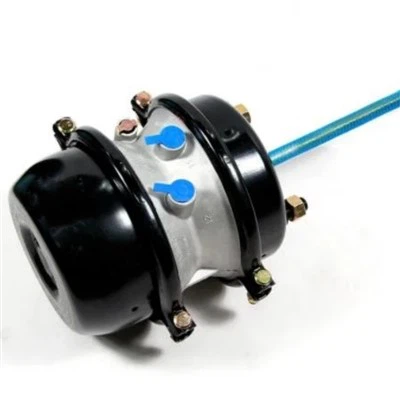


What is the Definition and Functionof the Brake Chamber?
The function of the air brake chamber is to convert the pressure of the compressed air into the mechanical force that makes the brake camshaft rotate to realize the braking action. The air brake chamber is a clamp clamp diaphragm type. The front and rear brake chambers are different in size, but their structure is basically the same.
Features
When the car is braking, air enters the brake chamber from the air inlet, deforms the diaphragm under the action of air pressure, pushes the push rod, and drives the brake adjustment arm, rotates the brake cam, and removes the brake shoe friction plate. Press against the brake drum to brake.
The braking force of the diaphragm air chamber push rod is proportional to the input air pressure; the parking brake sub-chamber is a braking device that uses spring energy storage and deflation. The inflation pressure enters the pressure chamber from port 12 to generate a force acting on the piston. When the pressure is greater than 0.65MPa, the force acting on the piston is greater than the preload force of the spring, and the piston moves up to the limit, and the brake is released; When the air is completely vented, the spring pushes the piston down and pushes the main brake push rod to produce braking. The braking strength is related to the spring preload. When the air pressure in the pressure chamber is lower than 0.65MPa, the braking force generated by the sub-chamber is inversely proportional to the air pressure value. , So you can implement emergency braking.
What are Air Brake Chambers?
Air brake chambers are the primary part of the air brake system in highway and long-haul 18-wheelers. While the front and rear brake chambers of a vehicle are slightly different, they function in conjunction with a set of oversize drum-brakes, taking the place of a normal breaking system's hydraulic assist function.
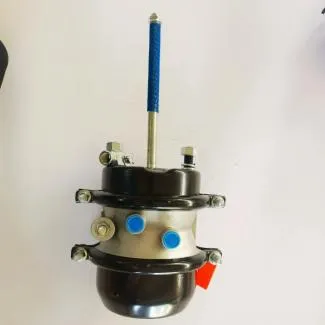
Front Brake Air Chamber
The front brake air chambers are solid steel housings connected to an air compressor. Each air brake chamber contains a pressure bleed valve and a push rod. The push rods have a spring return on the interior and a pressure plate the spans the width and depth of the chamber. When the brake pedal is depressed, air from the compressor is pumped into the chamber. This drives the push rod out with upwards of 1,000 pounds of force. Yoked to the end of the push rod is an S-cam.
The S-cam is a long rod that sits in the interior of the drum brakes. When it turns, it forces out the surrounding brake shoes against the interior of the wheel drums, arresting the tires. Air pressure is used because traditional hydraulic chambers would not be able to create sufficient fluid pressure to stop the tires as quickly.
Rear Spring Brake Air Chamber
Rear spring brake air chambers perform the same function as front brake air chambers, but they also double as a parking brake, thus their design is a little more complex. These are a dual-chamber system. The push rod and air chamber as present as usual, but behind this chamber is a second one which contains a powerfully coiled braking spring on a solid plate, much like the plate the push rod ends in. It's kept in check by a latch which connects directly to the parking break lever in the driver's cab.
The brake functions normally when the pedal is depressed, but if the parking brake lever is deployed, the latch snaps away from the spring and it manually drives the push rod forward with several hundred pounds worth of force. In order to disengage the parking brake, the brake pedal must be depressed, filling the first chamber with air and forcing the spring back until the latch catches hold of it again.

You may not be aware of the importance of your air brake chamber, but it is crucial to your car's safety. The chamber ensures that the brakes can stop your car when you need to at speeds up to 60 mph, and has a pre-fill volume of up to five cubic inches per axle. A non-rigid diaphragm adds an additional 12 cubic inches to this volume, giving you a total of 192 cubic feet per axle.
If your car has an air-brake system, you need to inspect and maintain it on a regular basis. The air brake chamber should be adjusted and serviced by qualified technicians. Also, you must maintain the pushrod stroke of the air brake chamber within regulation limits. If you still have problems, you may want to opt for a manual air brake adjuster. However, this is only recommended for older vehicles. In general, your car's air-brake chamber should be serviced every 20,000 miles.
Air-brake chambers are an integral part of air-brake systems on semi-trucks. They convert the force of air pressure into mechanical push rod force that engages brake shoes. The air-brake pushrods, located in each wheel, are capable of generating thousands of pounds of force. When they are engaged properly, the air brake pushrods stop the vehicle's wheels, preventing an accident. You must be respectful and cautious while working with air-brake chambers.
The air-brake chamber is installed on the front axle. It contains a single diaphragm that pushes a push rod in the right direction when air is forced into the chamber. The larger the air brake chamber, the greater the force it can generate, and this is crucial for vehicle control during panic stops. In order to install a replacement air brake chamber, you must ensure that it is the right size and meets manufacturer specifications.
Using the service chamber identification chart, you can identify the type of chamber by the type of mounting hardware. For example, a 30/30 brake chamber is for the service brake portion of the car, while a 30/36 chamber is for the emergency and parking sections. You may also see mixed chambers. If you cannot find any markings or tags, you can use measurements to determine the type of chamber. However, there are other types of brake chambers that don't have any markings.
When it comes to service brakes, it's important to keep in mind that the spring is under high tension, and can be released accidentally if it is not tightened. The spring is incredibly difficult to release accidentally. This is why it's crucial to use a new caging bolt for your spring brake chamber. You should also check the slack adjuster. A properly adjusted air brake chamber can make your car safer.
During service brake use, you can press the parking brake lever to release it. This action causes the push rod to drive forward with several hundred pounds of force. Then, you can disengage the parking brake by depressing the brake pedal. The parking brake must be able to hold a vehicle at its gross weight rating on a level surface that is dry, flat, and 20 percent grade. If the parking brake is not working properly, you should consider replacing it.

Whether your vehicle has drum brakes, disc brakes or both, it's important to maintain them on a regular basis. Ignoring brake issues (big or small) can lead to breakdowns and accidents — which may mean extended periods of downtime and loss of revenue. Make sure your brakes remain in good condition by:
Inspecting for worn-out, damaged or rusted components
Listening for unusual noises when pressing the pedal
Watching for warning signals on the dashboard
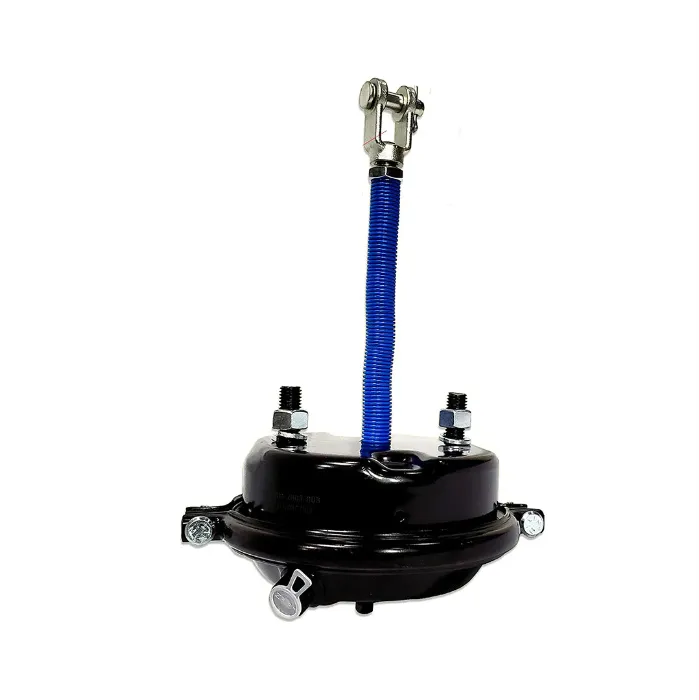
The Benefits of Spring Brake Chambers Using a Welded Yoke Clevis
For as long as there have been heavy-duty vehicles with air brakes, there have been concerns ensuring the proper length of a replacement brake chamber's push-rod, when changing chambers on commercial vehicles. Maintaining proper replacement brake chamber push-rod length (as determined by the vehicle's manufacturer) is not only a critical maintenance procedure, but is also a crucial step in maintaining the performance and efficiency of the vehicles braking system. Properly installing the correct brake chamber, with the correct push-rod length, is vital in assuring the vehicles ability to firmly hold while parked on grade, as well as the overall vehicle brake system capacity to stop the vehicle within a safe distance.
Previous Practices
For many years, all spring brake chambers installed on heavy-duty vehicles used a threaded push-rod that is cut to the proper length as specified by the manufacturer. These rod lengths may vary between vehicle manufacturers. Even different models within a single manufacturer could differ in the correct push-rod length. Many variables contribute to the varying push-rod lengths, including differing suspensions and axle configurations. To allow quick installation during production, heavy-duty vehicle manufacturers had OEM brake chamber suppliers pre-cut the push-rod to the proper length, thereby necessitating brake chambers at the factory with varying push-rod lengths depending on the models of heavy-duty vehicles built.
When brake chamber replacement becomes necessary in the aftermarket, aftermarket brake chamber manufacturers typically produced chambers with a universal 8-inch threaded push-rod as a "one size fits all" replacement part. This allowed for a universal replacement part, whereby a mechanic usually compared the push-rod length of the previous chamber, and cut the push-rod of the replacement chamber to match the length of the chamber being replaced. The issue then arose where mechanics failed to use proper procedures when cutting the threaded rod. This resulted in the vehicle brakes being set up improperly, causing problems such as inadequate parking brake performance (vehicles rolling when parked), increased vehicle instability during panic stops, or increased stopping distances during brake events. In the case of earlier model year vehicles that used manual brake adjusters, the push-rod length wasn't as critical as the brake adjuster was set manually, and could somewhat compensate for push-rod length error. This was an industry-accepted practice that masked this problem before the advent of automatic brake adjusters (ABA's). The automatic brake adjuster, mandated on all air-brake vehicles in 1995, didn't allow room for error in the proper cutting of the push-rod, and depends on the proper push-rod length in order to maintain automatic adjustment as designed.
Improvements
Around the 2000 model year, heavy-duty vehicle manufacturers were searching for methods to decrease duplicate part inventories in manufacturing. Since there could be many brake chambers used on a given truck model, the goal of the manufacturer was to set a common wheel-end design that called for a more unified application. Thus, a new actuator setup was released, which called for a much shorter push-rod than used in the past, and also had to fit all brake adjusters on the market. Due to this need, a new welded yoke push-rod was designed to replace the traditional threaded rod and clevis. Using one axle design as opposed to an assortment of designs, heavy-duty vehicle manufacturers were able to cut inventory costs and use one-rod length for the entire vehicle in most cases. Eventually, many heavy-duty vehicle manufacturers adopted the welded yoke brake chamber design in order to provide better efficiency in the production of the vehicle.
By the time these newer vehicles with welded yokes were ready for aftermarket chamber replacement, it was found that many shops still continued to use the 8-inch threaded rod to replace the welded yoke chamber. Because of the new welded yoke rod's shorter length (much less than those used in the past), it became a challenge in many shops to cut the rod correctly. It was at this time that the welded yoke brake chamber for the aftermarket was designed as a like-for-like replacement for the welded yoke factory installed brake chamber.
After the advent of the welded yoke brake chamber as an aftermarket replacement, it was soon discovered that the welded yoke brake chamber contained benefits the threaded rod counterpart had been missing. This included ease of installation and most importantly, proper rod length that assured efficient brake use and the brake adjuster's ability to maintain adjustment, thereby maintaining a safer, more stable commercial vehicle and less time involved which yields lower overall replacement cost.
The Benefits
Beyond the safety aspect, using the welded yoke brake chamber provides convenience and reduces the time necessary for brake chamber replacement. With threaded rod chambers, the task included cutting of the steel push-rod to the required length, followed by the installation of a separate clevis. With the welded yoke chamber these extra steps are eliminated. This then saves an average of 30 minutes of labor per brake chamber replaced, which decreases maintenance costs, as well as the vehicle downtime. Thus fleets using welded yoke brake chambers benefit from a decrease in down time and labor from road calls, in addition to properly maintained vehicles with properly performing brakes.
As an example, using the 30-minute savings per brake chamber based on the average shop labor rate of $130, this reduces labor costs by $65 on in-shop replacements, or $110 on the average road call. On a typical fleet replacing 30 brake chambers per year, this would result in savings of $1,950 for in-shop replacement or $3,300 on road calls, and any associated administrative costs.
Perhaps the largest benefit to the fleet operator is from a safety perspective as noted earlier. Improperly setup brakes can result in vehicle rollaway conditions, or increase the likelihood of a collision exposing the fleet to potential liability.
Fleet Use
Since the inception of the welded yoke brake chamber, fleets were slow to accept the design but soon came to realize the savings in time, labor and the safety assurance of a correct installation. Many safety managers nationwide viewed this as a way to ensure that the vehicles met safety standards for proper braking and overall vehicle control while reducing liability.
When the welded yoke was introduced, the chamber came in one rod length in a long-stroke configuration only. Due to the increased demand of the welded yoke brake chamber, there are currently many configurations available.
Air brakes utilize compressed air to press on a piston and apply pressure to the brake pad or brake shoe needed to stop or slow the vehicle. This contrasts with hydraulic brakes, which make use of hydraulic fluid rather than compressed air. Also known as pneumatic brakes, air brakes can either be drum brakes, disc brakes, or a combination of both. A compressor mounted on the engine is responsible for pressurizing the air and pumping it into storage tanks, where it is stored until it is needed. Most heavy vehicles have a gauge within the driver's view that indicates the air pressure stored. There are multiple air circuits in the system.
What are the Application Advantages of the Brake Chamber?
The brake air chamber is widely used in our various production fields. It can use air pressure as power to bring strong power to our raw tea, so it is widely welcomed by everyone. Now let us take a look. Is it widely used in these fields?
The brake air chamber is now mainly used in textile machinery, packaging machinery, printing machinery, textile machinery in these more important industrial fields, so its use has very important significance.
Of course, its use also brings us great convenience. It can cut off mechanical products. Through continuous braking air and better ventilation, it can provide power for our production. It can also be carried out when starting. Reversing, speed changing and other functions. The operation is very flexible and can be applied by ordinary operators.
In terms of structural design, the appearance is relatively simple, but the powerful functions are well received by customers. The stable performance and noiselessness make our production more convenient. Therefore, the huge advantage of the brake air chamber has a profound impact on our lives.
The brake chamber must give full play to its powerful and high quality when in use, which is more conducive to our production and allows us to better manufacture products.
Understanding Drum Brakes and Disc Brakes
Heavy duty truck brakes: Did you know it usually takes the length of two football fields for a semi-truck traveling at 65 mph to stop moving when brakes are operating normally? Because big rigs have longer stopping distances, it's important to understand the different types of brakes, how they function, and how to maintain them so you can drive and stop safely. Commercial vehicles have air brake systems that are equipped with drum or disc brakes (or both) — the information below can help you understand each type.
Drum brakes, How they function: Drum brakes are composed of the brake chamber, push rod, slack adjuster, S-cam (camshaft), rollers, shoes, lining, drum and return spring. When the brake pedal is pressed, pressurized air (stored in air reservoirs) travels to the brake chamber. This forces the push rod to actuate the slack adjuster, which rotates the S-cam. The rotation of the camshaft allows the rollers to spread the shoes apart and force the lining against the drum. As the lining rubs against the drum, kinetic energy (wheel movement) is converted into thermal energy (heat). The created friction causes the wheel to stop moving. Once the pedal is released, the return springs pull the shoes away from the drum back into resting position and allow the drum to resume rotating along with the wheel.
Comparing brake types: Drum brakes and disk brakes function similarly (turning kinetic energy into heat), but the way heat builds up when friction occurs is the primary difference. Learn how each type functions and their advantages and disadvantages.
Advantages: The benefits of drum brakes include:
Clean operation (free of dirt and other road debris since it's enclosed)
Inexpensive construction and installation
Simple maintenance
Cheap part replacement
Disc brakes, How they function: The primary components of disc brakes include the brake chamber, eccentric lever, power screw, brake pads and rotor. When the wheel is in motion, the rotor spins with it. As the pedal is pushed, compressed air travels to the brake chamber where the eccentric lever activates the braking force. The power screw then clamps the brake pads down on both sides of the rotor, causing friction to build up and stop the vehicle.
Advantages: The benefits of disc brakes include:
Easy inspection (wheel doesn't have to be removed)
The rotor is fully exposed to outside air (this helps keep it cool)
Resistant to wet weather (because they are fully exposed, water and debris can get off the rotor to help with performance)

Since air brakes run on air, minor leaks can be mitigated as more air is drawn in through the compressor. As a result, the system can still function in a capacity with a small leak. This differs from hydraulic systems where leaks result in continual losses with no fluid replacing what is lost.
Unlike hydraulic fluid, air can be compressed and energy can be stored. This is useful when the compressor fails, as it allows enough air pressure stored in the air tank to operate the brake chamber, even though no more air is being drawn in and compressed.
Air brakes can continue to work effectively even with significant leakage in the brake lines. Air brakes are also typically designed with a mechanical fail-safe that stops the vehicle safely using the parking brake in the event of failure.
Compressed air can also be utilized for accessories, such as air horns and seat adjusters. In a pinch, the engine mounted compressor can also be used to add additional PSI to a low tire, though doing so can damage your compressor.
Air hose couplings are easier to install and maintain when compared to hydraulic lines. You also don't need to "bleed" air brakes as part of maintenance.
Easier to couple to and uncouple from trailers. Air brakes are especially practical when in applications where trailers and constantly attached and removed.
Our Factory
We can produce the goods that customers need according to their different requirements, and will provide customers with more competitive prices while ensuring quality. At present, our company's products are sold well in more than 20 countries in Africa, Asia, and South America, and are deeply loved by customers and friends.

FAQ
Q: What is the purpose of brake chambers?
Q: What are the symptoms of a bad brake chamber?
Q: What does 30 30 brake chamber mean?
Q: Can you drive with a leaking brake chamber?
Q: Do you replace brake chambers in pairs?
Q: What is the difference between brake chamber and brake actuator?
Q: How can you tell if the brake master cylinder is bad?
Q: What is the difference between a spring brake chamber and a brake chamber?
Q: What is another name for a brake chamber?
Brake chambers are known by many terms including air brake chambers, maxi chambers, brake cans, and spring brakes.
Q: How do I know what brake chamber I have?
Q: What is the red mark on the brake chamber?
Q: What is the most common part that goes bad on the brake drum components?
You should always look for buildup of the abrasive material. In fact, the most common cause of excessive wear on the drums is built up abrasive material because of a dust shield or lack of dust shields.
Q: Do disc brakes have a brake chamber?
There are two types of air disc brake systems: exposed pushrod and direct mounted. The exposed pushrod style is rare and an older style of brake; the most common is the direct-mounted brake chamber style.
Q: Is it expensive to fix a brake leak?
Q: Do you open brake fluid reservoir when bleeding brakes?
Q: Can you have different size brake chambers on the same axle?
Q: What are the two types of brake chambers?
Q: Can you rotate a brake chamber?
Q: What happens when brake actuator fails?
Q: What is the most common symptom of a failed booster?
So, when the booster starts to fail, you will likely notice that the pedal is much harder to push down.
As one of the most professional brake chamber manufacturers and suppliers in China, we're featured by quality products and competitive price. Please rest assured to wholesale customized brake chamber made in China here from our factory.
18M Flatbed Trailer, American Type Brake Drum 3602R1, Germany Suspension